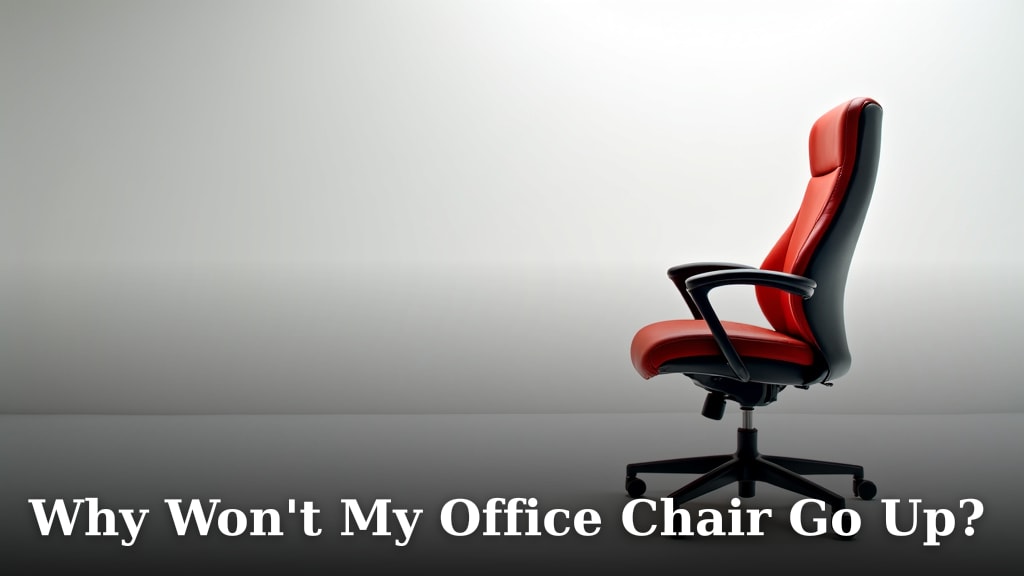
Why Won’t My Office Chair Go Up?
Your office chair won’t go up most likely because the gas lift cylinder has failed, preventing it from holding pressure. This is the most common reason for height adjustment issues.
You might also find your chair slowly sinking throughout the day. This is another clear sign of a faulty gas cylinder. Less often, a problem with the actuation lever or chair mechanism could be the cause.
- Gas lift cylinder failure is the top reason.
- Chair slowly sinking also points to a bad cylinder.
- Actuation lever issues are less common.
- Chair mechanisms can sometimes malfunction.
Let’s look into why your chair is misbehaving and what you can do about it, so you can get back to comfortable working.
Why Your Office Chair Isn’t Lifting
You’ve probably experienced that moment of frustration: you try to raise your office chair, and it just won’t budge. We understand how annoying this can be when you’re trying to find that perfect ergonomic position. The most common culprit, as research consistently shows, is usually a faulty gas lift cylinder (Occupational Health & Safety journal). This cylinder is the core component that allows your chair to move up and down smoothly.
Understanding the Gas Lift Cylinder
Think of your gas lift cylinder as a small, powerful pump. Inside, it contains compressed gas, typically nitrogen. When you activate the lever, a valve opens, allowing the gas to move and adjust the piston, which in turn raises or lowers your chair. It’s a simple, yet effective, piece of engineering that we often take for granted.
How Does a Gas Lift Cylinder Fail?
Over time, the seals inside the cylinder can wear out. This allows the compressed gas to slowly leak out. Once enough gas escapes, the cylinder can no longer hold its pressure. This means it can’t push your chair up anymore, or it might slowly sink throughout the day. It’s like a car tire with a slow leak – eventually, it just goes flat.
Another issue can be a bent or damaged piston rod. If the rod gets bent, it won’t move smoothly within the cylinder. This can prevent your chair from adjusting or cause it to get stuck at a certain height. Sometimes, you might even hear a faint hissing sound if the leak is significant.
Troubleshooting Common Chair Issues
Before you jump to replacing parts, let’s walk through some simple checks. Sometimes, the fix is easier than you think. You might just have a minor jam or a loose connection. It’s always a good idea to start with the simplest solutions first, right?
Check the Actuation Lever and Mechanism
The lever is your chair’s direct link to the gas lift cylinder. If the lever isn’t engaging properly, the cylinder won’t get the message to move. A common issue is the lever becoming disconnected from the mechanism underneath the seat.
Is the Lever Stuck or Bent?
Carefully inspect your chair’s height adjustment lever. Is it bent? Does it feel loose or wobbly? Sometimes, a bent lever simply isn’t pushing the release pin far enough to engage the gas cylinder. Try gently wiggling the lever to see if it catches. You might even find some debris preventing its full movement.
Inspecting the Chair’s Undercarriage
Flip your chair over or tilt it back to get a good look at the mechanism. You’ll see a metal rod connecting the lever to the top of the gas cylinder. Ensure this rod is still securely attached. We often find that a small clip or screw has come loose. Sometimes, the mechanism itself might be bent or cracked, preventing proper operation. A quick visual check can reveal a lot.
Obstructions and Weight Limits
It sounds simple, but sometimes the problem isn’t mechanical failure at all. An everyday object could be getting in the way. Also, be mindful of your chair’s weight capacity. Exceeding it regularly can definitely shorten the lifespan of your gas cylinder.
Look for Any Blockages
Are there any loose items, like a pen or a stapler, wedged under the seat? Even a small obstruction can prevent the mechanism from working correctly. We’ve seen situations where a child’s toy or a stray piece of paper was the culprit. Take a moment to clear anything that might be interfering with the movement.
Understanding Weight Capacity
Every office chair has a recommended weight limit. Constantly exceeding this limit puts undue stress on the gas lift cylinder. Think of it like carrying a backpack that’s too heavy every day – eventually, the straps will break. While not an immediate fix for a chair that won’t go up, it’s good practice to consider for future chair longevity (Ergonomics Today).
What Can You Do If Your Chair Won’t Rise?
So, you’ve checked the lever and looked for obstructions, but your chair still won’t go up. What’s next? Here are some steps you can take, ranging from simple fixes to considering replacement parts.
Temporary Fixes for a Sinking Chair
If your chair is slowly sinking, but not completely broken, you might be able to get a little more life out of it with some creative solutions. These aren’t permanent, but they can buy you some time.
Hose Clamp Method
This is a popular trick if your chair only sinks. You can get a hose clamp from a hardware store. Raise your chair to your desired height. Then, place the hose clamp around the base of the gas cylinder, just above the point where it enters the wheel base. Tighten it firmly. This acts as a physical barrier, preventing the cylinder from sinking past that point. It’s a bit of a hack, but many people find it useful.
PVC Pipe Solution
Another option for a sinking chair is using a piece of PVC pipe. Measure the exposed part of the gas cylinder when your chair is at your preferred height. Cut a piece of PVC pipe to that length. Then, you can cut the PVC pipe lengthwise and snap it around the cylinder. This creates a sturdy sleeve that stops your chair from sinking too low. Again, not a permanent repair, but it works in a pinch.

When It’s Time to Replace the Gas Lift Cylinder
If your chair won’t go up at all, and you’ve ruled out simple lever issues or obstructions, it’s highly likely that the gas lift cylinder needs to be replaced. Don’t worry, it’s a common repair that many people can do themselves.
Is Replacing the Cylinder Worth It?
This is a question many people ask. Generally, if your chair is otherwise in good condition – the seat is comfortable, the armrests are fine, and the base is stable – then replacing the gas lift cylinder is often a very cost-effective solution. A new cylinder is much cheaper than buying a whole new high-quality office chair. We’ve found that this DIY repair can save you a significant amount of money (Consumer Reports).
However, if your chair is old, wobbly, or showing signs of wear and tear in multiple areas, it might be time to consider a completely new chair. Evaluate the overall condition and decide if the investment in a new cylinder makes sense for your specific chair.
Steps to Replace Your Gas Lift Cylinder (Checklist)
Replacing a gas lift cylinder can seem daunting, but it’s usually straightforward. Here’s a quick checklist to guide you:
- Gather your tools: A rubber mallet, pipe wrench, and work gloves are often needed.
- Flip the chair over: This gives you access to the cylinder and base.
- Remove the chair base: The cylinder usually slots into the base; you might need to tap it out with a mallet.
- Detach the old cylinder from the seat mechanism: This might require some force with the pipe wrench.
- Insert the new cylinder: Push the new cylinder firmly into the seat mechanism.
- Reattach the chair base: Place the base onto the bottom of the new cylinder.
You can find many helpful video tutorials online that show the exact steps for your specific chair type. Always consult your chair’s manual if you have it.
Comparing Solutions for Your Chair Problem
To help you decide the best course of action, let’s compare the common solutions for a non-lifting office chair. This table summarizes when each option might be best for you.
| Problem Type | Likely Cause | Recommended Solution | Cost | Effort |
|---|---|---|---|---|
| Chair won’t go up at all | Failed gas lift cylinder, broken lever connection | Replace gas lift cylinder, or reconnect lever | Low to moderate | Moderate |
| Chair slowly sinks | Leaky gas lift cylinder seals | Replace gas lift cylinder, or temporary fixes (hose clamp/PVC) | Low to moderate | Low to moderate |
| Lever is bent or loose | Damaged lever or detached rod | Repair or replace lever/rod connection | Very low | Low |
| Chair stuck at one height | Gas lift cylinder jammed, or mechanism obstruction | Clear obstruction, or replace gas lift cylinder | Very low to moderate | Low to moderate |
Choosing the right path depends on the exact issue and your comfort level with DIY repairs. Don’t be afraid to try a simple fix first; you might surprise yourself with what you can accomplish.
Conclusion
Dealing with an office chair that won’t go up can be incredibly frustrating, but you now know the most likely culprit: a failing gas lift cylinder. While lever issues and obstructions can occur, the gas cylinder is almost always the core problem. You’ve learned how to identify these issues and even explored some clever temporary fixes to keep your chair usable.
Remember, replacing a gas lift cylinder is often a cost-effective DIY repair. By evaluating your chair’s overall condition, you can decide if a new cylinder or a brand-new chair is the best solution for your workspace. Take these steps, and get your ergonomic comfort back!
Frequently Asked Questions
Is it safe to keep using an office chair that slowly sinks?
While not immediately dangerous, a slowly sinking chair indicates a failing gas lift cylinder. This means it can no longer hold pressure properly. Continued use can be uncomfortable and affect your posture, potentially leading to back or neck pain over time.
How long do office chair gas cylinders typically last?
The lifespan of a gas lift cylinder varies greatly depending on usage frequency, user weight, and overall quality. On average, you can expect a good quality cylinder to last anywhere from 3 to 10 years. Heavier users or constant height adjustments can shorten this lifespan.
Can I replace the gas lift cylinder on any office chair?
Most standard office chairs use a universal gas lift cylinder that is relatively easy to replace. However, some high-end or specialized ergonomic chairs might have proprietary designs. Always check your chair’s specifications or consult the manufacturer if you’re unsure before purchasing a replacement.
What tools do I need to replace a gas lift cylinder?
You’ll typically need a few basic tools to replace a gas lift cylinder. A rubber mallet is essential for tapping out the old cylinder, and a pipe wrench can help detach it from the seat mechanism. Don’t forget work gloves to protect your hands during the process.
Where can I buy a replacement gas lift cylinder?
Replacement gas lift cylinders are widely available online through e-commerce sites like Amazon, or from office supply stores and specialized chair parts retailers. Make sure to measure your current cylinder or check your chair’s manual for the correct size and weight capacity before ordering.