
Can a Bad Chair Cause Herniated Disc?
The Link Between Sitting and Spinal Disc Problems
So, can your office chair really cause a herniated disc? The short answer is yes, it can be a major contributor. While a chair doesn’t “herniate” a disc on its own, poor sitting posture and lack of support can absolutely create the conditions for a herniation to occur or worsen. Think of it less like a single event and more like wearing down a rope by constantly rubbing it the wrong way.
Most herniated discs happen in the lower back, called the lumbar spine. Research from the National Institutes of Health (NIH) identifies degenerative changes and improper stress as key risk factors. Your daily chair is a huge source of that daily stress. When you sit for hours, especially in a bad position, you’re applying constant, uneven pressure to the soft discs between your vertebrae.
What Exactly Happens to Your Discs When You Sit?
Your spinal discs are like tough, jelly-filled donuts. The outer ring (annulus) is strong and fibrous. The inner jelly (nucleus pulposus) is soft and squishy. Their job is to cushion your bones. When you stand, pressure is distributed fairly evenly.
When you sit, the pressure on your lower back discs increases by about 40-90%, according to studies cited by the Cleveland Clinic. It’s like you’re gently squishing that jelly donut. Now, imagine doing that for 8 hours a day, 5 days a week. That constant squeeze, combined with slouching, can start to weaken the outer ring of the donut.
The Two Main Culprits: Posture and Pressure
Two things your bad chair likely encourages are the real villains in this story. They work together to put your discs at risk.
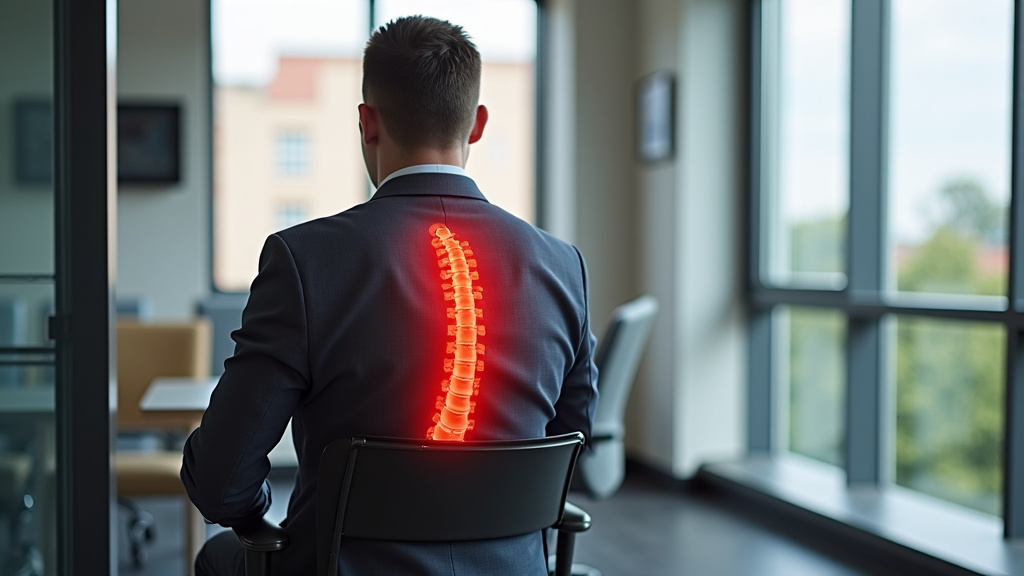
- Sustained Flexion: This is the medical term for slouching. When you slump, your lower back curves outward. This pulls on the back of the discs, pushing the jelly-like nucleus backward, right against the weakened outer wall.
- Static Loading: This just means sitting in one position without movement. Your discs don’t have their own blood supply. They get nutrients by a process of being compressed and released, like a sponge soaking up water. Staying still starves them of these essential nutrients, making them brittle and more prone to tears.
Is Your Chair the Problem? Warning Signs to Spot
You might be thinking, “My chair feels fine!” But “fine” doesn’t mean it’s good for your spine. Your body often gives you clues that your setup is working against you. Have you ever stood up from your desk and felt a sudden stiffness or a deep ache in your low back? That’s your first clue.
Pay attention to these common signs that your chair is a herniation hazard:
- You often find yourself sliding to the front edge of the seat.
- Your lower back loses contact with the chair’s backrest.
- You need to cross your legs or twist to feel comfortable.
- You experience tingling or numbness in your buttocks or legs after sitting.
- The end of your workday is always marked by a specific, localized back pain.
How to Tell if Back Pain is “Chair-Related”
Chair-related pain has a distinct pattern. It usually gets worse the longer you sit and feels better shortly after you stand up and move around. It often originates right at the base of your spine or on one side of your lower back. If your pain shoots down your leg, that’s called sciatica, and it’s a classic sign that a disc issue may be pressing on a nerve (Mayo Clinic). This is a clear signal to stop ignoring your chair situation.
The Anatomy of a Bad (and Good) Ergonomic Chair
An ergonomic chair isn’t just about luxury; it’s about creating a neutral, supported position. A bad chair does the opposite. It forces your body into harmful postures. Let’s break down the features.
| Feature | What a Bad Chair Does | What a Good Chair Enables |
|---|---|---|
| Lumbar Support | Is flat, non-existent, or in the wrong spot. Forces you to slouch. | Is adjustable and fits the natural curve of your lower back. Maintains spinal alignment. |
| Seat Height | Is too high or too low. Knees are above or below hips, tilting pelvis. | Allows feet to be flat on the floor, with knees at a 90-degree angle, hips slightly higher than knees. |
| Seat Depth | Is too deep, pressing into the back of your knees, or too shallow with no thigh support. | Leaves 2-3 fingers of space between the seat edge and the back of your knees. |
| Backrest Recline | Is fixed upright or reclines too far back without support. Encourages slumping. | Allows a slight recline (100-110 degrees) and offers lockable positions or smooth resistance. |
| Swivel & Casters | Is stuck in place, forcing you to twist your spine to reach things. | Moves smoothly, so you can reach items by rotating your whole body, not your back. |
Beyond the Chair: Your Overall Sitting Environment
Even the best chair in the world can’t save you if the rest of your setup is wrong. Your chair is one piece of the puzzle. A holistic approach to your workstation is what truly protects your discs.
We found that your monitor height, keyboard placement, and even your habits play a huge role. If your screen is too low, you’ll crane your neck forward, which throws off your entire spine. If your keyboard is too high, you’ll shrug your shoulders, creating tension all the way down to your back.
The Perils of “Working From the Couch”
Now, let’s talk about the home office trend. Working from your sofa or bed seems cozy, but it’s a herniation time-bomb. These surfaces offer zero lumbar support and encourage severe slouching. Your discs are under tremendous uneven pressure in these positions. If you must work from a soft surface, use a firm pillow behind your lower back. It’s a temporary fix, not a solution.
Movement is the Real Medicine: Breaking the Sitting Spell
The most important thing you can do for your discs isn’t buying a new chair—it’s moving. The human body was not designed for static sitting. Movement is what pumps nutrients into your discs and relieves built-up pressure.
Many experts recommend the 20-8-2 rule: for every 20 minutes of sitting, stand and move for 8 minutes, and spend 2 minutes in a different posture. This could be as simple as standing to take a phone call, stretching your arms overhead, or walking to get a glass of water.
Quick Stretches to Do at Your Desk
- Cat-Cow Stretch: While seated, gently arch your back up like a scared cat, then lower your belly and lift your chest like a cow. Repeat 5 times.
- Seated Spinal Twist: Sit tall and gently twist your upper body to the right, using the armrest for a light pull. Hold for 20 seconds, then switch sides.
- Knee-to-Chest Pull: While seated, grab one knee and gently pull it toward your chest until you feel a stretch in your lower back and glute. Hold, then switch legs.
Choosing Your Next Chair: A Quick Checklist
If you’ve determined your chair is part of the problem, here’s how to shop for a better one. Don’t just sit in it for 30 seconds in the store. Adjust every feature you can.
- Can you adjust the lumbar support so it fits snugly into your low back curve?
- With your feet flat on the floor, are your thighs parallel to the ground?
- Can you sit back with your shoulders against the backrest while still reaching your keyboard comfortably?
- Does the chair let you change positions easily, with recline and armrest adjustments?
- Is the seat pan depth adjustable or does it naturally fit your leg length?
Your Action Plan for a Healthier Back Today
Understanding the link is step one. Taking action is step two. You don’t need to overhaul everything at once. Start with small, consistent changes. Set a timer on your phone to remind you to stand and stretch every 30 minutes. Consciously check your posture and pull your shoulders back. Ensure your feet are flat on the floor.
Your daily habits, not just your chair, determine your disc health. Think of your spine as your most valuable investment. Protecting it with mindful movement and a supportive setup pays dividends for decades to come. You have the knowledge now—your back is counting on you to use it.
Conclusion
Your chair isn’t a direct cause, but it can be a powerful partner in creating the perfect conditions for a herniated disc. Remember, it’s the combination of sustained slouching and total stillness that starves and stresses your spinal discs. You now know how to spot the warning signs and understand the difference a supportive chair and frequent movement make. Don’t just read this and forget it. Your simple next step is to set a recurring timer on your phone for the next workweek. When it goes off, stand up, stretch, and consciously reset your posture. Your spine will thank you.
Frequently Asked Questions
Can sitting on the floor cause a herniated disc?
Sitting on the floor for long periods can definitely contribute to disc problems. It often leads to slouching and a rounded lower back, which places high, uneven pressure on your lumbar discs. The lack of back support is the key issue.
What are the very first signs of a herniated disc?
The earliest signs often include a dull ache in the lower back that worsens with sitting or bending. You might also feel stiffness upon standing up after being seated. In some cases, tingling or numbness in the buttocks or legs can begin.
Are there any exercises I should avoid with a herniated disc?
Generally, you should avoid exercises that involve heavy spinal flexion or twisting under load. This includes traditional sit-ups, heavy deadlifts, and toe touches. Always listen to your body and stop any movement that causes sharp pain.
How long does it usually take for a herniated disc to heal?
Recovery time varies widely. Many people see significant improvement in 4 to 6 weeks with proper rest and movement. More severe cases can take several months, and surgery recovery may add more time.
Can a new ergonomic chair fix my existing back pain?
A good chair is a critical tool, but it’s rarely a standalone cure. It works best as part of a broader plan that includes regular movement, core strengthening exercises, and posture awareness. Think of the chair as a supporter, not a magician.
