Gas Spring vs Mechanical Spring Monitor Arms: Which Is Better? (November 2026)
Pick a gas spring for smooth, set-and-hold adjustment and a mechanical spring for long term tension you can reset. In this spring vs gas monitor arm comparison, the ELG gas spring arm suits larger screens, while the HUANUO MechaSpring arm suits lighter screens and frequent moves.
On this page (11 sections)
- Spring vs gas monitor arm: the quick verdict
- Gas spring vs mechanical spring monitor arm side by side
- How gas spring arms hold your screen up
- How mechanical spring arms hold your screen up
- Adjustment feel: smooth, stiff or droopy
- Durability and wear over time
- Monitor compatibility: size, weight and VESA pattern
- Desk space, reach and cable control
- Setup, tension and care in plain steps
- Who should buy which arm
- Final verdict on spring vs gas monitor arm
Pick a gas spring arm for smooth support and a mechanical spring arm for resettable tension. In this guide, the ELG gas spring arm fits larger 17 to 35 inch screens, while the HUANUO MechaSpring arm fits lighter 13 to 32 inch screens and frequent moves.
Our score weighs specs, features and buyer feedback against what you are shopping for. We compared the 4 arms below on reach, capacity, tilt, mounting and tension design.

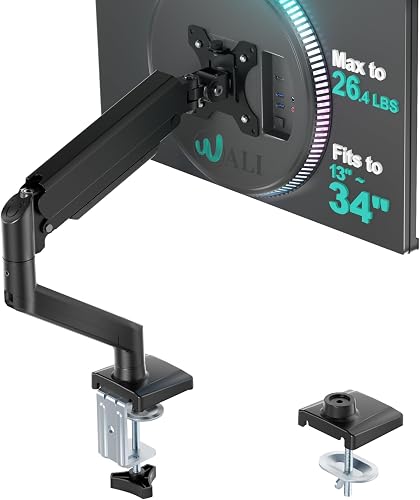 Best for flat screens up to 34 inches
WALI Adjustable Single Monitor Arm for 13-34
| Product | Best for | Reach | Screen size | Capacity | Our score |
|---|---|---|---|---|---|
| ELG Gas Spring Monitor Arm | large ultrawide screens | 20.9 in | 17-35 in | 19.8 lb | 9.7 |
| WALI Adjustable Single Monitor Arm for 13-34 | flat screens up to 34 inches | 19.3 in | 13-34 in | 26.4 lb flat | 9.6 |
| ErGear Single Monitor Arm | quick tool free setup | 18.1 in | 13-34 in | 19.8 lb | 9.5 |
| HUANUO FlowLift Pro Monitor Arm for 13-32 | lightweight screens and frequent moves | 18.7 in | 13-32 in | 15.4 lb | 9.5 |
Spring vs gas monitor arm: the quick verdict
Gas spring arms use sealed pressure to hold position. Mechanical spring arms use a metal spring you can adjust to match your screen.
The ELG arm uses a gas spring and reaches 20.9 in, the longest here. It fits 17 to 35 in screens up to 19.8 lb, including many 24 in, 32 in and 34 to 35 in ultrawides.
The HUANUO FlowLift Pro uses MechaSpring design for 13 to 32 in screens from 4.4 to 15.4 lb, suited to lighter screens and frequent moves. Gas pressure can fade in some designs, while mechanical tension can be reset with correct setup.
Our guide to computer monitor arms covers VESA plates, clamps and cable channels. Our vertical laptop stand with docking station guide helps if you dock a laptop here.
Gas spring vs mechanical spring monitor arm side by side
The table below shows the real split in capacity, reach and tension design. Use weight first, then size, then reach.
| Arm | Spring type | Screen size | Capacity | Reach |
|---|---|---|---|---|
| ELG Gas Spring Monitor Arm | Gas spring | 17-35 in | 19.8 lb | 20.9 in |
| WALI Adjustable Single Monitor Arm for 13-34 | Counterbalance arm | 13-34 in | 26.4 lb flat | 19.3 in |
| ErGear Single Monitor Arm | Counterbalance arm | 13-34 in | 19.8 lb | 18.1 in |
| HUANUO FlowLift Pro Monitor Arm for 13-32 | MechaSpring mechanical | 13-32 in | 15.4 lb | 18.7 in |
The gas spring example here is the ELG arm. It uses calibrated resistance that holds the screen when you let go, with testing to 20,000 adjustment cycles.
Mechanical spring here means the HUANUO MechaSpring arm, with 90 percent metal construction and up to 2 times the service life of conventional mounts, per HUANUO.
The WALI and ErGear arms show full motion benchmarks for reach, tilt and VESA design, though only HUANUO is named as a mechanical spring.
For a plain explainer, read what is a gas spring monitor arm.
How gas spring arms hold your screen up
A gas spring arm uses sealed pressure to balance screen weight. You push the screen up or down and the pressure pushes back.
That gives a set-and-hold feel. The ELG arm holds position the moment you let go.
The force is set for a weight range. Too light or too heavy and the arm feels stiff or droops, so ELG limits it to 17 to 35 in and up to 19.8 lb.
Tilt is +85 degrees backward and -30 degrees forward, a 115 degree total range for seated and standing users.
At 20.9 in, ELG also gives about 1.6 to 2.8 in more reach than the other arms here at 18.1 to 19.3 in.
Spring vs gas monitor arm: gas spring pros and cons
Gas spring arms shine when you set the screen once and move it in small steps. The ELG arm is a strong fit for that habit.
Key facts: ELG fits VESA 75x75 and 100x100 mm. It includes C-clamp and grommet mounting for desks 0.39 to 3.5 in thick.
It has a built in cable organizer.
The trade off is pressure loss over time. Some gas designs can lose pressure and need more force to move.
ELG counters that with a 20,000 cycle test claim, but you should still check that your screen is within the stated weight range.
If you prefer gas spring models in general, our best gas spring monitor arm guide narrows the field by size and weight.
How mechanical spring arms hold your screen up
A mechanical spring arm uses a metal spring and tension control to balance the screen. You change tension to match the screen weight.
The HUANUO FlowLift Pro makes that process visible. Its PrecisionView window has a yellow indicator that moves as you adjust tension.
HUANUO calls the design MechaSpring and says it does not rely on gas pressure, so tension can be reset as the arm ages.
Weight is the limit. HUANUO fits 13 to 32 in screens weighing 4.4 to 15.4 lb.
A heavier screen is not the right fit, even if the size looks right.
It reaches 18.7 in and raises 16.5 in above the desk. Tilt is +85 to -25 degrees, swivel is plus or minus 90 degrees and rotation is plus or minus 90 degrees.
Mechanical spring arms for frequent moves
Mechanical spring arms suit people who move the screen often. Code, design and video work can mean many small changes each day.
HUANUO's LockSteady system is meant to resist droop and move with light force. HUANUO says the arm is TÜV Rheinland certified and tested at 3 times its load.
That claim is specific to HUANUO. It does not mean every mechanical spring arm has the same test result.
Check the stated load and cycle claims for the exact model you buy.
The HUANUO arm uses aluminum and a tool free VESA plate. You snap the screen in place instead of holding it while you start screws.
That helps if you swap screens or set up a second desk.
Adjustment feel: smooth, stiff or droopy
The right arm feels light to move and firm when you stop. Too stiff means force does not match your screen, while too loose means droop.
ELG holds with calibrated resistance for controlled small moves, but a gas spring cannot be tuned like a visible tension dial. HUANUO is built for tuneability, and its PrecisionView window shows tension change as you turn it.
WALI extends 19.3 in, raises 17.3 in, swivels plus or minus 180 degrees, tilts +70 to -45 degrees and rotates 360 degrees, with a core tested through 20,000 plus cycles. ErGear reaches 18.1 in with height up to 17.5 in, tilts +80 to -50 degrees, swivels plus or minus 90 degrees and rotates 360 degrees.
If your screen droops, check tension and weight first. Do not force a too heavy screen past its limit.
Durability and wear over time
Durability comes down to cycle testing, metal build and how tension is maintained. No spring type wins on every point.
ELG says its gas spring is tested to 20,000 adjustment cycles, about 54 years at one adjustment per day. Real wear still depends on screen weight and daily moves.
HUANUO says its MechaSpring arm offers up to 2 times the service life of conventional mounts. It also states 90 percent professional grade metal construction for this model.
WALI says its durable core is tested through 20,000 plus cycles. ErGear makes the same claim, with a 40 percent wider VESA head for stability.
The honest split is that gas designs can lose pressure, while mechanical designs can lose tension setting, so a visible tension control helps you check and reset it.
What wears out first
Joints, VESA plates and cable clips wear as well as springs. Check those parts if the screen starts to wobble.
ELG uses carbon steel and ships with 1 bracket and 1 accessories kit for installation. WALI uses metal and a wider VESA head with a tighter fitting panel.
ErGear uses alloy steel and a 40 percent wider VESA head.
Cable management also affects wear. ELG has a cable organizer through the arm.
WALI guides wires along the arms. ErGear uses cable clips that open with no tools required.
Keep cables loose enough for full tilt and swivel. Tight cables can pull the screen down at the edge of its range, and that pull can look like spring failure.
Monitor compatibility: size, weight and VESA pattern
Size alone will not tell you if an arm fits. Weight and VESA pattern decide first, so check all 3 before you order.
ELG fits 17 to 35 in screens up to 19.8 lb with VESA 75x75 or 100x100 mm. That covers many 24 in 4K, 32 in curved and 34 to 35 in ultrawide screens, if weight fits.
WALI fits 13 to 34 in screens up to 26.4 lb for flat screens and 19.8 lb for curved screens. Its flat capacity is the highest in this group.
ErGear fits 13 to 34 in flat or curved screens up to 19.8 lb with 75x75 or 100x100 mm patterns and tool free VESA mounting. HUANUO fits 13 to 32 in screens from 4.4 to 15.4 lb with 75x75 or 100x100 mm patterns.
The spring vs gas monitor arm weight check
Weigh the screen without its stand, then compare it with the arm limit. That step prevents most compatibility errors.
Measure the 4 VESA holes on the back of the screen. They should form a 75 mm or 100 mm square for all 4 arms here.
Check desk thickness next. ELG fits 0.39 to 3.5 in.
WALI fits 0.39 to 2.76 in. ErGear fits 0.39 to 2.56 in for C-clamp and 0.39 to 2.95 in for grommet.
HUANUO fits wood desks 0.59 to 3.54 in.
WALI warns to install only on a wooden desk with no crossbeam blocking the underside. HUANUO also recommends wood desks only.
Desk space, reach and cable control
Reach changes how your desk feels more than brand names do. Longer reach moves the screen past your keyboard and frees the front of the desk.
ELG leads at 20.9 in of reach. WALI extends 19.3 in, HUANUO extends 18.7 in and ErGear reaches 18.1 in, a gap that matters on deep desks.
Height range also matters. WALI raises up to 17.3 in, ErGear adjusts up to 17.5 in and HUANUO adjusts 16.5 in, with the top of the screen at or just below eye level for seated work.
Cable control keeps the clean look. ELG routes cables through the arm, WALI guides wires along the arms, ErGear uses clips that open with no tools and HUANUO helps hide wires.
Our best monitor arm with cable management guide compares channel and clip design.
Setup, tension and care in plain steps
Set up the arm with the screen attached, then set tension for that exact weight. An empty arm can feel very different from a loaded arm.
Start with the clamp or grommet base on a suitable desk edge. ELG and WALI include both options, as do ErGear.
HUANUO offers C-clamp and grommet base mounting.
Mount the screen with correct VESA screws. ErGear and HUANUO use tool free VESA designs that reduce setup time.
ELG and WALI use standard VESA mounting.
Set tension before you fine tune height. For HUANUO, watch the yellow PrecisionView indicator.
For gas spring arms, check the screen stays level at high, low and forward positions.
Move the screen through tilt and swivel with cables attached. If a cable pulls tight, reroute it before you call the spring weak.
A note on gas cylinders and office chairs
A monitor arm gas spring is not the same part as an office chair gas cylinder. Do not mix the two when you shop for parts.
If your chair is sinking or feeling unstable, that is a separate issue. Our guide on Can You Replace Office Chair Gas Cylinder? explains when replacement is an option.
For a step by step chair fix, read How to Replace Office Chair Gas Cylinder?. That guide does not fix a monitor arm, and a monitor arm guide will not fix a chair.
For the monitor arm, keep the arm clean, check VESA screws over time and avoid hanging extra weight from the arm.
Who should buy which arm
Buy by screen weight first, then by how often you move the screen.
Pick the ELG Gas Spring Monitor Arm for a 17 to 35 in screen up to 19.8 lb and the longest reach at 20.9 in. It suits large 4K and ultrawide screens that stay in one main position.
Pick the WALI Adjustable Single Monitor Arm for 13-34 for a flat screen near 26.4 lb or for 180 degree swivel and 360 degree rotation. It suits high capacity flat screens needing wide side motion.
Pick the ErGear Single Monitor Arm for tool free VESA mounting and quick setup for 13 to 34 in screens up to 19.8 lb. Pick the HUANUO FlowLift Pro Monitor Arm for 13-32 if your screen weighs 4.4 to 15.4 lb and you move it often.
Skip HUANUO over 15.4 lb, skip ELG under 17 in, and skip any arm that does not match your 75x75 or 100x100 mm VESA pattern.
Final verdict on spring vs gas monitor arm
Choose gas spring for set-and-hold smoothness and mechanical spring for visible, resettable tension. The right pick depends on weight, move frequency and desk fit.
For larger screens, the ELG gas spring arm is the clear pick in this group. It pairs 20.9 in reach with 17 to 35 in fit and +85 to -30 degree tilt.
For lighter screens and frequent moves, the HUANUO MechaSpring arm is the clear pick. It pairs 4.4 to 15.4 lb fit with a PrecisionView window and tool free VESA plate.
For high flat screen capacity, the WALI arm leads with 26.4 lb capacity and 19.3 in extension. For fast setup, the ErGear arm leads with tool free VESA mounting and 18.1 in reach.
Reweigh your screen, check VESA holes and measure desk thickness before you order.
Frequently asked questions
What is the main difference between a gas spring and a mechanical spring monitor arm?
A gas spring uses sealed pressure to counterbalance the screen, so it holds position with light force. A mechanical spring uses a metal spring and tension control, so you can reset tension as parts wear.
Both aim to stop screen droop during adjustment.
Which spring type lasts longer?
It depends on use and design. HUANUO says its MechaSpring design offers up to 2 times the service life of conventional mounts, while ELG says its gas spring is tested to 20,000 adjustment cycles.
Check the weight range for your screen before you choose either type.
Can a gas spring arm hold a 34 inch ultrawide?
Some can, if the screen weight and VESA pattern fit. The ELG arm fits 17 to 35 inch screens up to 19.8 lb, and the WALI arm fits screens up to 34 inch.
Weigh your screen with its stand removed, then compare that number with the arm capacity.
How do I choose between gas and mechanical spring arms?
Choose gas spring if you want smooth set and hold movement and rarely change screens. Choose mechanical spring if you move the screen often, swap monitors, or want visible tension control.
In both cases, match screen size, weight, VESA pattern and desk thickness first.


