9 Best Ergonomic Split Keyboards (November 2026)
The best ergonomic split keyboards include the Arteck Split Ergonomic Keyboard with Palm Rest for simple wireless office setups, the Logitech Ergo K860 Wireless Ergonomic Split Keyboard for multi-device desks, and the Arteck Split Ergonomic Keyboard with Palm Rest for wired backlit typing.
On this page (7 sections)
The best ergonomic split keyboard for most Windows users is the Arteck 2.4G model, with a cushioned palm rest, number pad and rechargeable battery. Choose Logitech for Bluetooth and multi-device use, or KINESIS for adjustable tenting, contoured key wells and programmable layouts.
A split layout changes where your hands rest on the desk. The best choice depends on whether you want a familiar full-size layout, a compact gaming board, a wireless setup, a deep ergonomic shape or a simple wired connection.
If you're comparing a keyboard and mouse together, start with our ergonomic keyboard and mouse guide. For a chair that supports long desk sessions, see the Best Ergonomic Office Chair and Best Office Chair For Cad Design Work guides.
Our picks at a glance
-
1
 Best for simple wireless office setups
Arteck Split Ergonomic Keyboard with Palm Rest
9.7/10 our score
See it on Amazon -
2
 Best for multi-device desks
Logitech Ergo K860 Wireless Ergonomic Split Keyboard
9.5/10 our score
See it on Amazon -
3
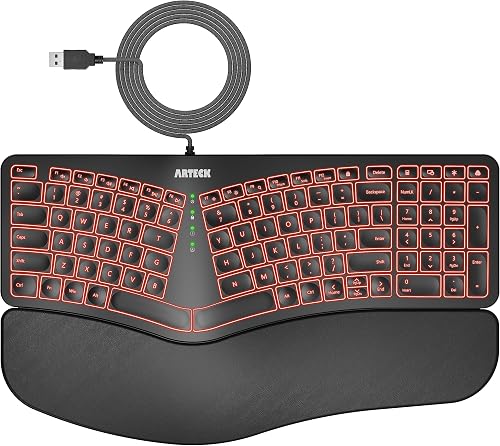 Best for wired backlit typing
Arteck Split Ergonomic Keyboard with Palm Rest
9.4/10 our score
See it on Amazon
- 4
 Check it
KINESIS Advantage360 Professional Split Ergonomic Keyboard
Best for advanced tenting and programming - 5
 Check it
KINESIS Freestyle Edge RGB Plus Split Mechanical
Best for RGB mechanical gaming - 6
 Check it
Frixalox Wired Ergonomic Split Keyboard with RGB
Best for full-size RGB office typing - 7
 Check it
MEETION Ergonomic Keyboard and Mouse
Best for a keyboard and mouse bundle - 8
 Check it
RK ROYAL KLUDGE S70 Ergonomic Split Keyboard
Best for compact wireless gaming - 9
 Best for compact wired Windows typingCheck it
The best ergonomic split keyboard picks
The Arteck 2.4G is the strongest all-around choice because it combines wireless setup, a palm rest, a number pad and rechargeable power. The other models suit buyers who need Bluetooth, backlighting, advanced tenting, mechanical switches, a bundled mouse or a smaller footprint.
Our score weighs specs, features and buyer feedback against what you're shopping for. We compared the split layout, connection type, typing angle, wrist support, size, power and software needs of these 9 keyboards.
Arteck Split Ergonomic Keyboard with Palm Rest: Best for simple wireless office setups
- 2.4G USB wireless connection
- Cushioned wrist and palm rest
- Rechargeable battery
- 102 keys with number pad
The Arteck gives Windows users a familiar full-size layout with split key sections, a cushioned palm rest and a rechargeable battery.
Pros
- Rechargeable battery
- Number pad and media keys
- Foldable legs for typing angle
Cons
- Windows layout
- Uses a USB receiver
The Arteck 2.4G model is the best starting point for a Windows desk that needs a familiar full-size keyboard. Its split keyset design, cushioned wrist and palm rest, number pad and media keys cover common office tasks without requiring a deep contoured layout.
The keyboard measures 16.5 x 9.6 x 1.02 in and has 102 keys. Four foldable legs let you adjust the typing angle, while the low-profile scissor keys are designed for quiet typing.
A keyboard tray for ergonomic typing can also change the keyboard position below the desk.
Setup uses the nano USB receiver stored at the back of the keyboard. The rechargeable lithium battery lasts up to 6 months based on 2 hours of use per day, and the keyboard works up to 33 ft or 10 m from the receiver.
Choose it if you want wireless freedom and a palm rest without Bluetooth pairing. Its Windows layout means Mac users should expect some keys and functions to differ.
Logitech Ergo K860 Wireless Ergonomic Split Keyboard: Best for multi-device desks
- Bluetooth and USB connectivity
- Curved split keyframe
- Memory foam wrist rest
- Adjustable palm lift
The Logitech Ergo K860 combines a curved split frame with Bluetooth, USB connectivity and an adjustable palm lift for mixed-device desks.
Pros
- Works across major desktop operating systems
- Bluetooth and USB options
- Adjustable palm lift
Cons
- Full-size footprint
- Uses 2 AAA batteries
The Logitech Ergo K860 is the best ergonomic split keyboard here for a desk that moves between Windows, macOS, Linux and Chrome OS devices. Its curved split keyframe, pillowed memory foam wrist rest and adjustable palm lift focus on a more supported typing position.
The palm lift offers 0, -4 and -7 degree settings for seated or standing desks. That choice matters when you change height during the day and want your wrists to stay level without resetting the whole layout.
Logitech also gives you Bluetooth and USB connectivity, so you can choose the connection that fits your computer setup. Bluetooth suits a laptop that moves around the desk, while the USB receiver can be a steadier option for a fixed desktop.
Its 78-key QWERTY layout includes an integrated number pad and quiet Perfect Stroke keys. The scooped keys give each fingertip a clearer place to land, which can help during long typing sessions.
The keyboard uses 2 AAA batteries and measures 17.95 x 9.17 x 1.89 in, so allow more depth than you would for a compact model. Check the space in front of your monitor before you buy, especially if your desk already holds a large mouse or speaker.
Choose it for mixed-device work and adjustable palm support. For a smaller wireless option, compare it with our best wireless split keyboard guide.
Arteck Split Ergonomic Keyboard with Palm Rest: Best for wired backlit typing
- USB wired connection
- 7 backlight colors
- Cushioned wrist rest
- 101-key layout
This wired Arteck adds adjustable backlighting to a split Windows layout with a cushioned wrist rest and a 6 ft cable.
Pros
- No charging or pairing
- 7 backlight colors
- Number pad
Cons
- Windows layout
- Cable limits desk placement
This wired Arteck is a practical pick when you want split ergonomics and backlighting without charging or wireless pairing. Its cushioned wrist and palm rest supports the hands, while the 1.8 m, or 6 ft, USB cable gives you room to place the keyboard on a larger desk.
The keyboard has 101 keys and a number pad. That full layout keeps spreadsheet work and data entry familiar, even though the key sections are split for a more relaxed hand position.
Its low-profile scissor keys are paired with 7 backlight colors and adjustable brightness, which can help you see the keys in a dim room. You can lower the light for evening work or raise it when the room is brighter.
The connection is plug and play on Windows desktop and laptop computers. There is no receiver to store, no Bluetooth menu to manage and no battery to watch from week to week.
The model also includes media and Windows shortcut keys, but its Windows layout can have different functions on Mac. Mac owners should expect to learn a few changed legends and key combinations.
Choose it if a fixed cable is acceptable and you want backlighting for late work. If you need a compact travel model, see the best portable split keyboard guide.
KINESIS Advantage360 Professional Split Ergonomic Keyboard: Best for advanced tenting and programming
- Contoured split key wells
- 3 adjustable tenting heights
- Quiet mechanical switches
- Bluetooth and wired USB-C
The Advantage360 Professional is for users who want contoured key wells, adjustable tenting, quiet mechanical switches and programmable layouts.
Pros
- 3 tenting heights
- Separate modules
- Major operating system support
Cons
- Learning curve from its orthogonal layout
- Premium palm pads sold separately
The KINESIS Advantage360 Professional is the most advanced ergonomic split keyboard in this roundup. Its contoured key wells, orthogonal layout, thumb keys, integrated tenting and separate modules give you more control over hand position than a flat split board.
You can choose from 3 adjustable tenting heights and separate the halves by up to 10 in with the included cable. Start close together if you are new to this shape, then widen the gap in small steps as your shoulders settle.
The quiet Kailh Box Pink Silent mechanical switches use low activation force and are rated for 50 million presses. Low force can reduce the effort needed for each keystroke, while the silent stem keeps the sound lower than a clicky switch.
Bluetooth supports up to 4 devices, and wired USB-C connectivity is also available. That mix helps if you type on a work laptop during the day and a personal machine at night.
The keyboard works with Windows 7–11, macOS, Linux and Chrome, with programmable layouts through its onboard tools. Power users can move common commands to easier keys, but that freedom also takes time to set up well.
The deep shape requires more adjustment than the Arteck or Logitech. Premium palm pads are sold separately, so factor that into your wrist-support plan.
KINESIS Freestyle Edge RGB Plus Split Mechanical: Best for RGB mechanical gaming
- Hotswap linear switches
- RGB lighting
- Detachable palm support
- Lift kit and Mac keycaps included
The Freestyle Edge RGB Plus suits PC users who want split mechanical typing, hotswap switches, RGB effects and a lift kit.
Pros
- Hotswap switch support
- Fully programmable
- Mac keycaps included
Cons
- USB-A connection
- Windows software requirement
The KINESIS Freestyle Edge RGB Plus is the best ergonomic split keyboard here for PC users who want mechanical switches, RGB lighting and gaming controls. Its modules can be split or splayed, while the lift kit raises the thumb side to change the typing angle.
The keyboard uses hotswap linear switches and supports 3-pin and 5-pin MX-style switches. Hotswap sockets mean you can change switches later without soldering, which makes it easier to find a weight and feel that suits your hands.
It also includes detachable palm support, Mac keycaps and a USB cable. The palm support can be removed if you prefer a cleaner desk or need the halves closer to your mouse.
RGB lighting offers 11 effects, and the SmartSet Engine supports remapped keys, macros, hotkeys and profiles. You can keep one profile for typing and another for games, then switch as the task changes.
The keyboard connects through USB-A and is designed for PC use with Windows 10 or later. A wired link avoids charging and keeps input steady during gaming sessions.
Choose it for a wired mechanical setup with strong customization. For more gaming-focused comparisons, read Best Split Keyboards for Gaming.
Frixalox Wired Ergonomic Split Keyboard with RGB: Best for full-size RGB office typing
- Full-size layout with number pad
- 17 light modes
- Integrated wrist rest
- USB-A with USB-C adapter
The Frixalox combines a familiar full-size layout with RGB lighting, an integrated wrist rest, adjustable kickstands and a wired connection.
Pros
- Number pad and 17 shortcuts
- USB-C adapter included
- No batteries or charging
Cons
- Wired only
- Flat split layout may need adjustment
The Frixalox suits office users who want a full-size split keyboard with RGB lighting, a number pad and a firm integrated wrist rest. Its flat split-key design stays closer to a familiar keyboard feel than the deeply contoured KINESIS options.
It has 120 keys, 17 dedicated shortcuts and a 5.6 ft USB-A cable. The shortcuts cover media, volume, brightness and common system tasks, so you may use the mouse less for everyday controls.
The included USB-C adapter helps connect it to computers with different ports, and the keyboard works with Windows, macOS, Chrome OS and Linux without driver installation. That makes it simple to move between an older desktop and a newer laptop.
The RGB system includes 10 dynamic rainbow modes, 7 solid colors and 5 brightness levels. You can use a plain color for focused work and a moving effect when you want the desk to look livelier.
Two pairs of adjustable kickstands provide 3 typing angles, while the hard plastic palm rest is easy to wipe clean. A firm rest suits people who press down more while typing, but softer cushioned rests may feel better for lighter hands.
Choose it if you want wired reliability and full-size controls. It is not a Bluetooth or 2.4G wireless keyboard, and it is not designed for PS5 or Xbox consoles.
MEETION Ergonomic Keyboard and Mouse: Best for a keyboard and mouse bundle
- Full-size curved split layout
- 2.4G and Bluetooth
- Cushioned palm rest
- Included ergonomic mouse
The MEETION set gives you a full-size curved keyboard and an ergonomic mouse with 2.4G and Bluetooth connection choices.
Pros
- Keyboard and mouse together
- Switches between compatible devices
- Adjustable mouse DPI
Cons
- Uses replaceable batteries
- Large desk footprint
The MEETION set is the best choice when you need an ergonomic split keyboard and mouse together. Its full-size curved layout includes a number pad and cushioned palm rest, while the included mouse has a contoured shape, thumb support and 4 adjustable DPI levels.
The keyboard measures 17.4 x 9.24 x 1.78 in, so check your desk depth before choosing it. A large frame needs room for the palm rest, and a shallow desk may push the keyboard too close to your body.
It supports 2.4G wireless through the included USB receiver and Bluetooth for compatible computers and laptops. You can use the receiver for a stable desktop link and Bluetooth when you move a laptop to another surface.
The mouse DPI settings let you slow the cursor for detailed work or raise it for faster movement across a wide monitor. That range helps if you share the set between documents, design work and general browsing.
This is a replaceable-battery setup rather than a rechargeable one. The keyboard uses 2 AA batteries and the mouse uses 1 AA battery, so keep replacements available if you work away from a power outlet.
Choose it if a matching mouse is useful and you switch between compatible devices. The pronounced curved sections may take longer to learn than a standard flat keyboard.
RK ROYAL KLUDGE S70 Ergonomic Split Keyboard: Best for compact wireless gaming
- 75% split mechanical layout
- 2.4G, Bluetooth and USB-C
- 8 adjustable feet
- 5 programmable macro keys
The RK S70 saves desk space with a 75% split layout while adding wireless connections, adjustable feet, RGB lighting and macro keys.
Pros
- Compact footprint
- Hot-swappable switches
- Wireless and wired modes
Cons
- Right half needs a cable
- Software is for Windows
The RK ROYAL KLUDGE S70 is the compact wireless pick for users who want a split mechanical keyboard without a full-size footprint. Its 75% layout saves desk space while keeping wireless 2.4G, Bluetooth and USB-C connections.
Eight adjustable feet let you change the typing angle, and the fixed wrist rest supports the palms. You can flatten the board for a neutral reach or raise the feet when you want a gentle slope toward your wrists.
The keyboard has 5 programmable macro keys on the left side, RGB lighting and hot-swappable linear creamy switches. The macro keys are useful for repeated gaming commands or work shortcuts that you use many times each day.
The built-in 3150mAh battery can last up to 2 weeks without backlight. Turning the lighting down or off is therefore one of the easiest ways to stretch the time between charges.
The left half can retain wireless and macro functions for one-handed use, but the right half needs the coiled cable to operate. Plan your desk so that cable does not pull on the right module during fast mouse movements.
Choose it for compact gaming or programming desks. Windows software handles remapping, macros and lighting, while Mac and Android compatibility is listed for device use.
Perixx PERIBOARD-524B US: Best for compact wired Windows typing
- Compact TKL layout
- Up to 2 ft separation
- Adjustable tilt angle
- Low-profile membrane keys
The Perixx PERIBOARD-524B is a compact wired Windows keyboard with separated halves, adjustable tilt and low-profile membrane keys.
Pros
- Compact TKL footprint
- Up to 2 ft separation
- Adjustable typing angle
Cons
- Windows only
- No backlight
The Perixx PERIBOARD-524B is the simplest compact wired option in this group. Its TKL layout has 86 low-profile membrane keys, and the two sections can separate by up to 2 ft.
The curved split-key design and adjustable tilt let you change the keyboard's angle and spacing. Placing the halves in a slight triangle can help your arms stay closer to your sides during long sessions.
Wide wrist rests on both sides give your palms a place to sit during longer typing sessions. Because the split moves with the key sections, each hand can settle without stretching across a fixed center bar.
It connects through USB-A and is designed for Windows 7, 8, 10, 11 and later versions. A wired link keeps setup simple and avoids batteries, receivers or Bluetooth pairing.
Its dimensions are 14.21 x 8.46 x 1.1 in, making it shorter than the full-size Arteck, Logitech and Frixalox models. That shorter length leaves more room for a mouse, notebook or monitor stand.
Choose it when desk space matters more than backlighting, Bluetooth or mechanical switches. Its compact Windows layout leaves out the number pad found on several larger picks.
How to choose an ergonomic split keyboard
Choose the connection type before comparing key feel. A wired keyboard avoids charging and pairing, while wireless models reduce cable clutter but require a receiver, Bluetooth setup or battery management.
A split keyboard can be one connected frame, two linked halves or two wireless modules. The Arteck and Logitech keep a one-piece feel, the Perixx allows up to 2 ft of separation, and the Advantage360 Professional allows up to 10 in with its cable.
What should an ergonomic split keyboard layout feel like?
An ergonomic split keyboard should let you place your hands without forcing the wrists inward. Start with the halves close together, then adjust separation in small steps while keeping your shoulders relaxed and your elbows near your sides.
Flat split boards such as the Frixalox may feel more familiar. Deeply shaped boards such as the KINESIS Advantage360 change key position and hand angle more strongly, so allow time to learn the layout.
Is tenting useful on a split ergonomic keyboard?
Tenting changes the height of the thumb side of the keyboard. The Logitech uses adjustable palm lift settings, the RK S70 has 8 adjustable feet, and the KINESIS models offer a lift kit or multiple tenting heights.
Start with a low angle and increase it only if the position feels natural. A taller tent can reduce the space available for a wrist rest or change how your fingers reach the keys.
Choosing split keyboards for different work
A full-size model makes sense if you use a number pad often. The Arteck, Logitech, Arteck wired model, Frixalox and MEETION all keep number-pad access, while the Perixx uses a compact TKL layout and the RK S70 uses a 75% layout.
Programmers may prefer programmable layers, macro keys or a layout that keeps the mouse closer. The Advantage360 Professional and Freestyle Edge RGB Plus offer deeper customization, while the RK S70 adds 5 macro keys.
For Mac use, check the operating system support and key layout before buying. The Logitech supports macOS, the Frixalox works with macOS, and the KINESIS Advantage360 Professional supports macOS.
The Arteck models use Windows layouts.
If you need a number pad, read Best Split Keyboards with Number Pads. For Apple users, compare Best Split Keyboards for Mac.
Mechanical, membrane and low-profile keys
Mechanical switches give you a more defined switch feel and support options such as linear, silent or tactile typing. Linear switches move in a straight line, tactile switches give a small bump, and clicky switches add sound on top of that bump.
The KINESIS Advantage360 Professional uses quiet Kailh Box Pink Silent switches, while the Freestyle Edge and RK S70 use mechanical switch systems. Those choices suit people who want a stronger key feel or who like to tune a keyboard over time.
Hotswap support adds another layer of choice on the Freestyle Edge and RK S70. You can change switches without soldering, but you should check that replacement switches match the socket type and pin count.
Membrane and scissor-style keys can feel closer to a standard office keyboard. The Arteck models use scissor construction, the Frixalox uses membrane switches and the Perixx uses low-profile membrane keys.
Those flatter designs often suit shared offices where a loud mechanical board would be unwelcome. They also keep the keyboard profile low, which can make a desk feel less crowded.
There is no single best switch type for every desk. Choose mechanical switches if customization and key feel matter most, or choose membrane and scissor keys if you want a flatter, quieter office style.
For a deeper mechanical comparison, see Best Mechanical Split Keyboards and Best Ergonomic Mechanical Keyboards.
Wireless and wrist-rest features
Wireless models work best when the receiver or Bluetooth connection matches your computer. The Arteck uses a 2.4G USB receiver, the Logitech supports Bluetooth and USB, the MEETION supports 2.4G and Bluetooth, and the RK S70 supports 2.4G, Bluetooth and USB-C.
A 2.4G receiver usually sits in a USB port and works without a pairing menu. Bluetooth can connect directly to many laptops, but you may need to re-pair when you move between machines.
USB-C wired use can charge some wireless boards while you type. The RK S70 can also work through a cable, which is handy if you forget to charge it before a long session.
A wrist rest should support the palm without making you bend the wrist upward. The Logitech has a pillowed memory foam wrist rest, while the Arteck, MEETION and Frixalox use integrated or cushioned palm support.
Soft foam can feel kind for readers and writers who pause often. A firmer rest may suit faster typists who keep their hands moving and need a stable surface.
Fixed rests are ready to use right away and do not shift during typing. Detachable rests give you more choice, but you need to check that they stay aligned with the split halves.
Battery type also shapes daily care. Rechargeable models reduce waste but need a cable and time to refill, while replaceable AA batteries can be swapped in seconds.
If wrist support is your main reason for switching, compare Best Split Keyboards with Wrist Rests. For wireless mechanical options, see Best Wireless Split Mechanical Keyboards.
More guides on this topic
- Best Perixx Split Keyboards for a closer look at compact wired models from the same maker, including how separation and tilt change the feel of a smaller desk.
- Best Split Keyboards for Programming if you want layouts that keep symbols, layers and shortcuts close while giving your mouse more room.
- Best Keychron Ergonomic Keyboards to compare another popular maker with a range of familiar and split layouts for office and home use.
- Best Split Keyboards with Tenting when the angle of your wrists matters more than a standard flat typing position.
- Best Wireless Ergonomic Mechanical Keyboards for wireless boards that pair a mechanical switch feel with a more supportive split shape.
Verdict: which best ergonomic split keyboard should you buy?
The Arteck 2.4G is the best ergonomic split keyboard for most Windows office desks because it combines wireless setup, a rechargeable battery, a number pad and a cushioned palm rest.
It is the easiest starting point if you want comfort without learning a deep contoured layout. The familiar key sections, media keys and foldable legs make daily office work feel close to a standard keyboard.
Pick the Logitech Ergo K860 for Bluetooth and multi-device work. Its adjustable palm lift and memory foam rest suit people who move between a laptop and a desktop.
Pick the KINESIS Advantage360 Professional for deep tenting and programmable contoured typing, or choose the Freestyle Edge RGB Plus for wired mechanical gaming. Those models reward patience and setup time with more control over hand position.
The Perixx is the compact wired choice, while the Frixalox gives you full-size controls and RGB lighting. The wired Arteck adds backlighting for dim rooms, and the RK S70 saves space with a 75% layout.
If you need both input devices, the MEETION keyboard and mouse set is the most direct match. Measure your desk first, then match the connection, layout and wrist support to the way you actually work.
Our top 3 picks at a glance
-
1
Best for simple wireless office setups
Arteck Split Ergonomic Keyboard with Palm Rest
9.7/10 our score
See it on Amazon -
2
Best for multi-device desks
Logitech Ergo K860 Wireless Ergonomic Split Keyboard
9.5/10 our score
See it on Amazon -
3
Best for wired backlit typing
Arteck Split Ergonomic Keyboard with Palm Rest
9.4/10 our score
See it on Amazon
Frequently asked questions
What is the best ergonomic split keyboard for most people?
The Arteck 2.4G model is the best ergonomic split keyboard for most Windows users in this group. It combines a split design, cushioned palm rest, number pad, media keys and rechargeable power.
Choose Logitech if you need Bluetooth and multi-device support, or KINESIS if you want deeper tenting and programmable layouts.
Are split keyboards more ergonomic?
A split keyboard may allow more flexible hand placement than a straight keyboard. Separating the key sections can let you position your hands closer to shoulder width, while tenting can change the angle of the thumb side.
Comfort depends on your desk, posture, hand position and adjustment period.
How long does it take to get used to an ergonomic split keyboard?
Many people need several days or longer to adjust to a split ergonomic keyboard. Start with the halves close together and use short practice sessions before increasing the separation or tenting.
A familiar flat layout, such as the Arteck or Frixalox, may feel easier than a deeply contoured model.
What is the difference between a split keyboard and an ergonomic keyboard?
A split keyboard separates or angles the key sections so your hands can sit in different positions. An ergonomic keyboard may also add a curved frame, tenting, palm support, low-force switches or programmable keys.
Some models are split and ergonomic at the same time, while others use only one of those features.


